
Techsylvania has grown into one of the largest tech gatherings in Central and Eastern Europe, drawing founders, engineers, and product leaders from across the region for two days of panels on AI, product, and growth.
We spent time in the sessions, connected with founders and engineers between talks, and learned how other teams are tackling challenges similar to the ones we face. This year’s panels kept returning to one question: teams everywhere are shipping faster with AI, so what happens to judgment, testing, and trust when they don’t scale at the same speed? We went in carrying that same question, and found the answer scattered across five very different rooms.
AI works best as an amplifier, not a replacement
The clearest thread was this: AI tools work best when they strengthen human decision-making, not when they stand in for it. Experience, intuition, and a real read on customer needs stay essential even as the tools get more powerful. A point the panel “Beyond the Algorithm: Intuition in the World of AI” made early and one that echoed through the rest of the event.
What that looks like in practice is learning to work well alongside AI. “Becoming Irreplaceable in the Age of AI” puts a finer point on it: adaptability and continuous learning are the skills that matter most going forward, alongside critical thinking, creativity, and leadership. A model can’t supply any of those on its own.
Andrew Watts, who ran a product for Amazon Prime Video, framed the same idea through Amazon’s “Working Backwards” method: start from a real user need, then reach for the technology that serves it. Technology follows the problem, a simple rule, and an easy one to lose sight of when the tooling is this exciting.
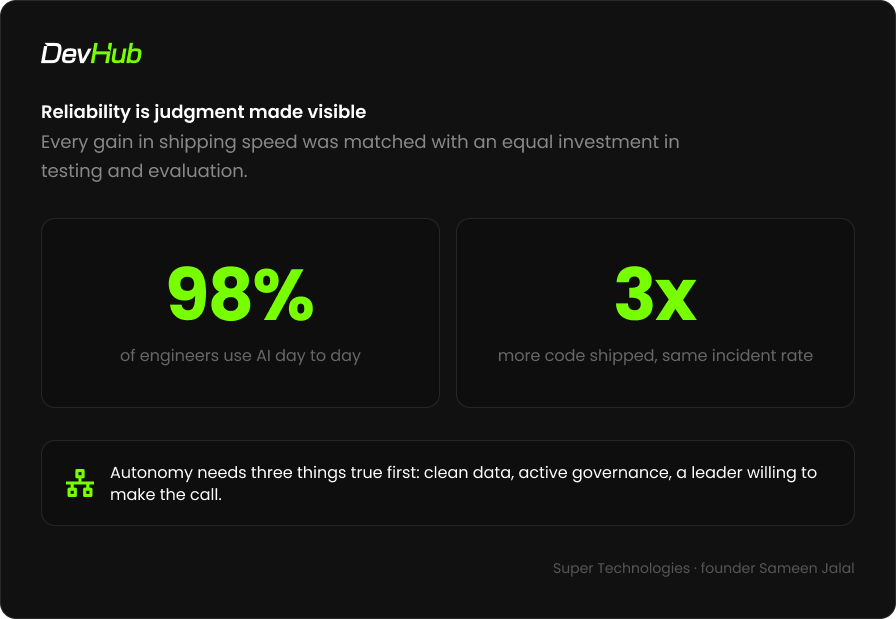
Reliability is judgment made visible
That amplifier only holds up once AI touches something that can actually break in production, and that’s where judgment gets tested hardest. Building an AI solution is only part of the job; reliability, security, and scalability carry equal weight, and once AI touches business-critical data, strong guardrails and validation stop being optional.
That was the core argument behind “The System Behind a Production-Ready SQL Agent,” and it plays out concretely at Super Technologies, where 98% of engineers now use AI day to day and the team shipped roughly three times more code last year without a rise in incidents. Founder Sameen Jalal’s explanation had nothing to do with the model itself: every gain in speed was matched with an equal investment in testing and evaluation.
Push that logic to its edge and you get autonomy, and that’s where the line gets drawn hardest. Before a team hands anything over to an autonomous system, three things need to be true: the data has to be clean, governance has to be active rather than nominal, and someone in leadership has to be willing to make the call. Monica Garza, formerly VP of IT at Adidas, was blunt about it, missing one of those three, and the system doesn’t survive contact with real use.
We’re already treating that as internal policy: testing and monitoring scale up alongside the AI, at the same pace it gets adopted, not after.
Constraints build sharper products
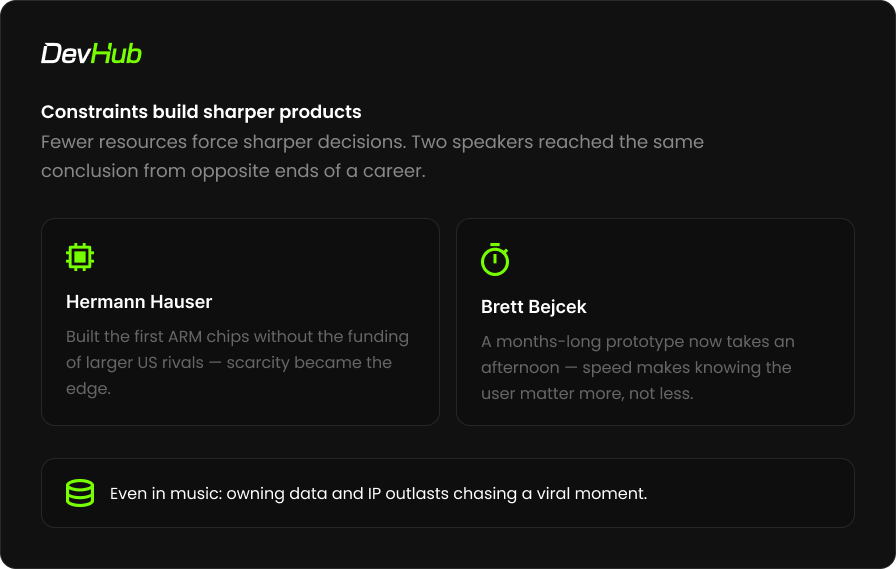
Reliability wasn’t the only discipline on display. The conversation also turned to working with less, and fewer resources, it turns out, force sharper decisions. Two speakers made that case from opposite ends of a career and arrived at the same place. Hermann Hauser, who helped build the first ARM chips at Acorn decades before founding Amadeus Capital Partners, did it without the money or headcount his much larger US competitors had and argued that a lack of resources can become a team’s biggest competitive edge, forcing decisions a well-funded competitor never has to make.
Brett Bejcek, founder of Click Clack Labs, got there from the opposite direction: the barrier to building has collapsed so far that a prototype which once took months can now come together in an afternoon. That speed makes knowing your user more important than ever, since a fast build still has to solve the right problem.
Even the music industry made the same case. Artists now operate like businesses, with brand, technology, partnerships, and fan engagement all factoring into success. Ownership of data, and intellectual property is becoming a long-term asset, and building a real community pays off more than chasing a short-term viral moment.
It’s a line of thinking we’re holding onto as we scope our own roadmap: a tighter brief tends to produce the sharper product, and the audience we build around our work outlasts any single launch.
Trust is built, not claimed
None of the above works without trust, and trust doesn’t scale the way code does. Credibility grows day by day, Hrvoje Ćosić told the room, and in finance it can disappear fast. As CEO of Aircash, he scales his team on fit more than markets or seniority, his test is simple: could he have a beer with someone and talk football afterward? If not, the hire probably wasn’t right.
Lian Boerma, Chief Product Officer at EWOR, reached a similar conclusion by a different route. She described turning founder support, something deeply human and hard to replicate into a scalable system built on three pillars: matching founders with the right talent, connecting them with investors and exited founders who know the journey firsthand, and grounding the curriculum in principles from neuroscience. The system scales. The trust underneath it still has to be earned one relationship at a time.
From the team: what it felt like on the ground
“Techsylvania left me with the impression that we’re at a point where the industry’s rules are being rewritten in real time. The pace at which people talk about what’s coming next pulls you out of your bubble and forces you to update your view on the upcoming years. You go from an OpenAI talk about how AI is scaling in Europe, to a panel about the post-biological era, to one about engineering leadership from MongoDB’s former CTO, and along the way you realize they’re all connected. AI, once a niche topic, is now in every conversation.”
— Andrei Ghiriti, QA Automation Engineer
What we're taking back
The panels didn’t always share a topic, but the ideas kept circling back to the same core: AI extends what a good team can do, it doesn’t replace the judgment, taste, and trust that made the team good in the first place.
Reliability comes from deliberate engineering choices, not from whichever model happens to be newest. And the teams building real advantages right now are the ones treating both of those as requirements rather than nice-to-haves. That’s the thread we carried out of the room with us, and it’s already turning into sharper questions about our own systems and product decisions.