
Releasing software can feel like a high-stakes moment. The code has been tested, the deployment is ready, and then suddenly thousands or millions of users are interacting with it. But releasing software doesn’t have to be an all-or-nothing event.
Modern teams are increasingly using release strategies that make changes smaller, more controlled, observable, and easier to reverse. The goal isn’t just to ship faster. It’s to reduce the risk that comes with shipping.
Deployment vs. release
One of the most important ideas in modern release management is separating deployment from release.
Deployment means getting code into production.
Release means making that functionality available to users.
Traditionally, these two things happen at the same time. A developer deploys version 2.0, and suddenly 100% of customers are using version 2.0. That creates a problem: if something goes wrong, the entire user base discovers it at roughly the same time.
That’s why teams need more control and progressive delivery. If something looks wrong, the team pauses or rolls back before the problem reaches the entire customer base.
Common release strategies
There isn’t one strategy that works for every release. The right approach depends on the risk and complexity of the change.
Rolling deployments
Rolling deployments gradually replace old application instances with new ones. They’re relatively simple and work well for routine, backward-compatible changes.
Blue/green deployments
Blue/green deployments maintain two environments: one running the current version and another running the new version. Traffic can be switched between them, making rollback relatively straightforward. The trade-off is additional infrastructure and cost.
Canary releases
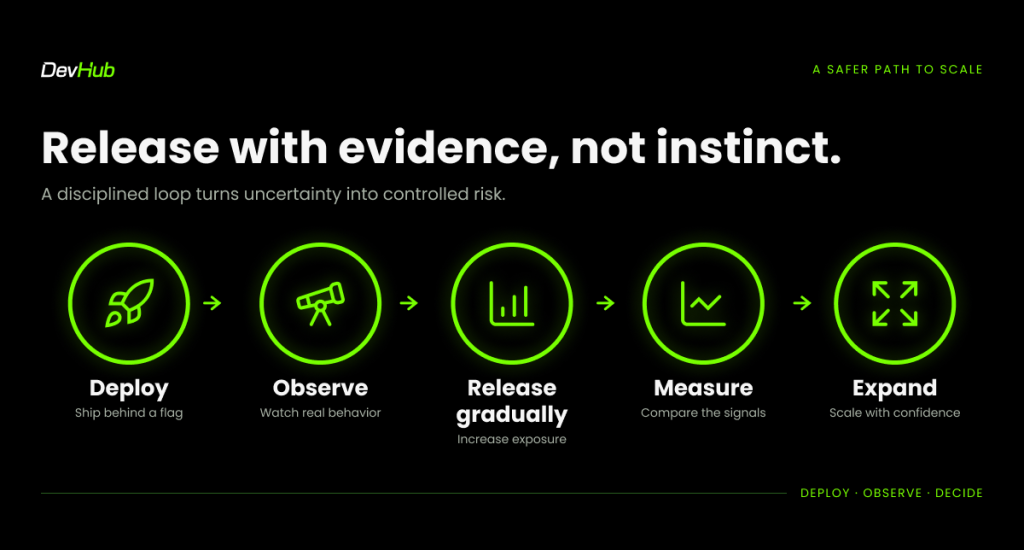
Canary releases send a small percentage of production traffic to the new version first. If the metrics look healthy, the rollout expands. If something goes wrong, the team can stop the rollout before everyone is affected.
Feature flags
Feature flags control whether users can access functionality independently of deployment. They’re particularly useful when you want to release gradually or turn a feature off quickly without redeploying.
These strategies can also be combined. For example, a team might deploy behind a feature flag, expose the feature to 1% of users, monitor the results, and then gradually increase exposure.
Observability makes progressive releases work
Gradual releases are only useful if you know what is happening. Teams should define the signals that determine whether a rollout is healthy.
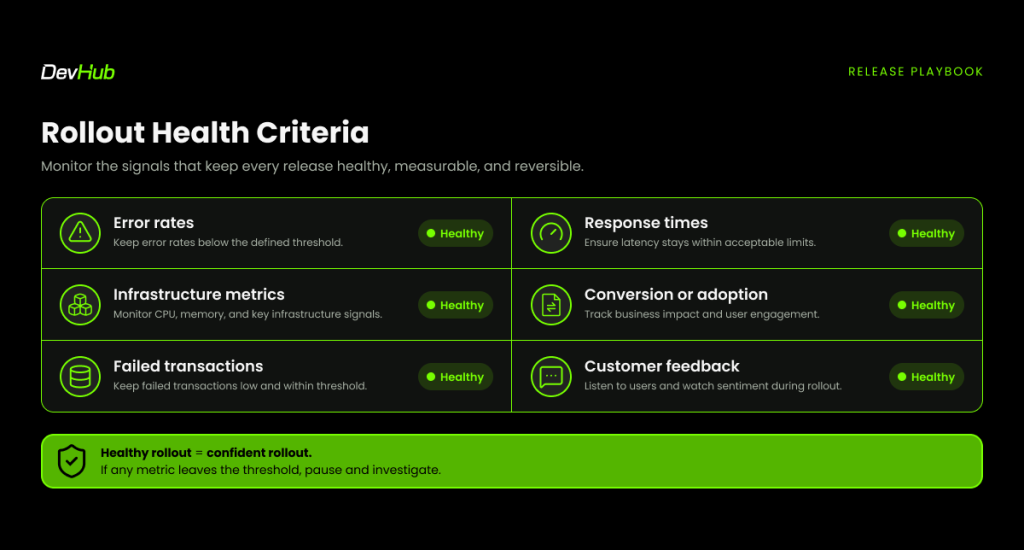
The important part is deciding what success and failure look like before starting the rollout. A canary that reaches 5% of users without anyone checking its health isn’t really a safety mechanism. It’s simply a slower release.
Always have a rollback plan
Every release should have a clear answer to one question: “What happens if something goes wrong?”
Depending on the strategy, rollback might mean switching traffic back to the previous environment, stopping a canary, redeploying the previous version, or disabling a feature flag. The best rollback process is one that is fast, predictable, and tested.
It’s also important to remember that not everything is easily reversible. Database and API changes, for example, may require backward-compatible migration strategies so that old and new versions can safely coexist.
The goal is controlled risk
No release strategy can eliminate risk completely. Tests can miss edge cases, production traffic behaves differently from staging, and users will always find unexpected ways to use a product.
Canary releases limit the blast radius. Blue/green deployments make switching versions easier. Feature flags separate deployment from user exposure. Observability provides the feedback needed to make decisions, and rollback gives teams a way out when something doesn’t go as planned.
Ultimately, a good release strategy makes software releases less of an event to fear and more of a controlled process. That makes it possible to ship frequently while giving both engineering teams and users a safer experience.