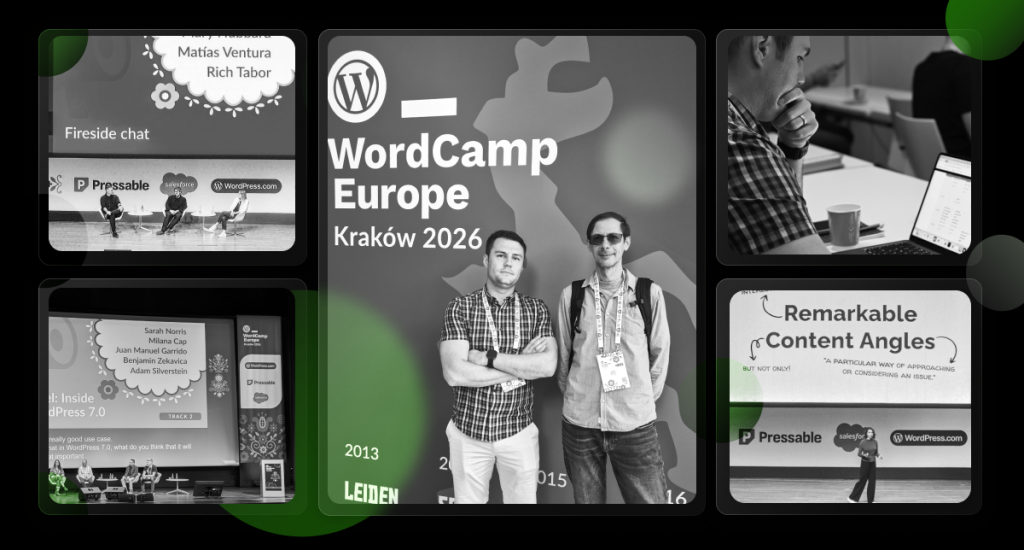
WordCamp Europe brings together the developers, content creators, and businesses that use the most popular CMS on the Internet. This year, two of our colleagues made the trip to Kraków to see what the WordPress world is building toward.
One side followed the technical track: WordPress core updates, security, and the new mechanics of search. The other covered the business and editorial sessions, and what it takes for brands to protect their voice and capture attention in a crowded market. The takeaways from both tracks reflect the practical changes happening across the WordPress environment right now, starting with the hands-on workshops.
The practical side of the conference
Across two days, our colleagues moved through presentations and hands-on workshops that covered development, business strategy, AI, and content.
One session focused on breaking complex projects into clearly defined tasks. It started with a simple exercise: write down every step it takes to make a toast. It sounds trivial until you realize how differently people break down the same process. The workshop used that gap to build a shared approach to task definition that scales to real projects.
The workshop on AI-assisted testing took a similar process-driven approach but applied it to quality assurance. Participants practiced writing prompts for Claude to evaluate how accurately a built site matched the original design and brandbook. The exercise showed the strengths of automated QA, as well as the exact points where human review remains essential. A separate session tackled development, where attendees built a custom WordPress plugin from scratch that integrates directly with AI tools like Claude and Gemini.
On the business side, one workshop ran through the Business Model Canvas from Strategyzer, a framework for mapping out the business context around a client and understanding their actual needs before putting together a marketing mix. For the developer track, a dedicated session covered plugin approval criteria. More exactly, what it takes to get a plugin into the WordPress repository and what tends to get submissions rejected.
Preparing for WordPress 7.0
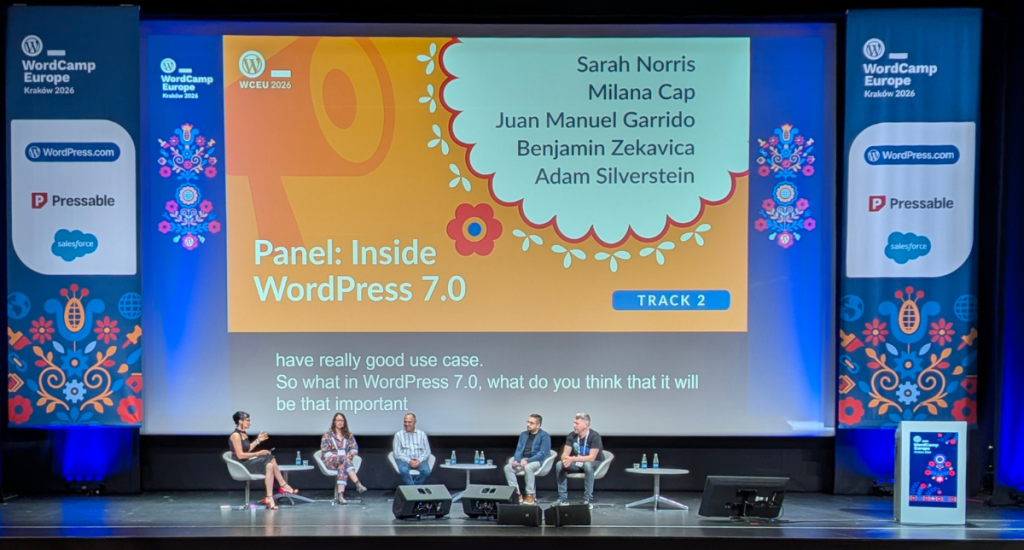
One of the more anticipated sessions was a panel bringing together core contributors for an open discussion about WordPress 7.0. Rather than walking through a feature list, the panelists mapped out upcoming release milestones, debated architectural changes, and outlined the long-term direction of the platform.
What made it worth attending was the reasoning behind the decisions, not just the decisions themselves. Features that are still being planned and rewritten tend to come with a lot of context that never makes it into release notes. To hear the technical arguments play out in real time gave the team an early look at what to expect from the next major release.
The Intersection of AI and Brand Voice
Several presentations across the content and SEO tracks approached the same problem from different angles: what happens to a brand’s voice when AI-generated content becomes the default?
The content strategy sessions made a direct case for why an authentic brand voice matters more now than ever. When AI-generated content is everywhere, brands that sound like everyone else get lost. Therefore, treating brand voice as a strategic asset is something worth defining and protecting, especially now.
Visibility in search now depends heavily on becoming the source that automated engines extract and credit. The SEO sessions covered what that means in practice: how to optimize site architecture for crawlers from Gemini, ChatGPT, Claude, and Perplexity, and how to structure content so that AI agents actually reference it in their responses.
Final thoughts
The main takeaway from this year is that success now depends on how well teams can balance automation and human judgement — whether that means using Claude to speed up website testing, writing code that follows standards, or structuring content so AI search agents can easily cite it.