

Most teams didn’t consciously decide to adopt AI-driven workflows. A code assistant crept in during one sprint, a summarization tool during another, an automated pipeline someone built and never documented. Suddenly the question shifted from “should we use AI?” to “why isn’t ours working?”
The gap is rarely technical. According to MIT’s Project NANDA, 95% of enterprise generative AI pilots deliver no measurable business impact, not because the models underperform, but because the surrounding organization wasn’t structured to use them.
What do we actually mean by "AI-driven workflow"?
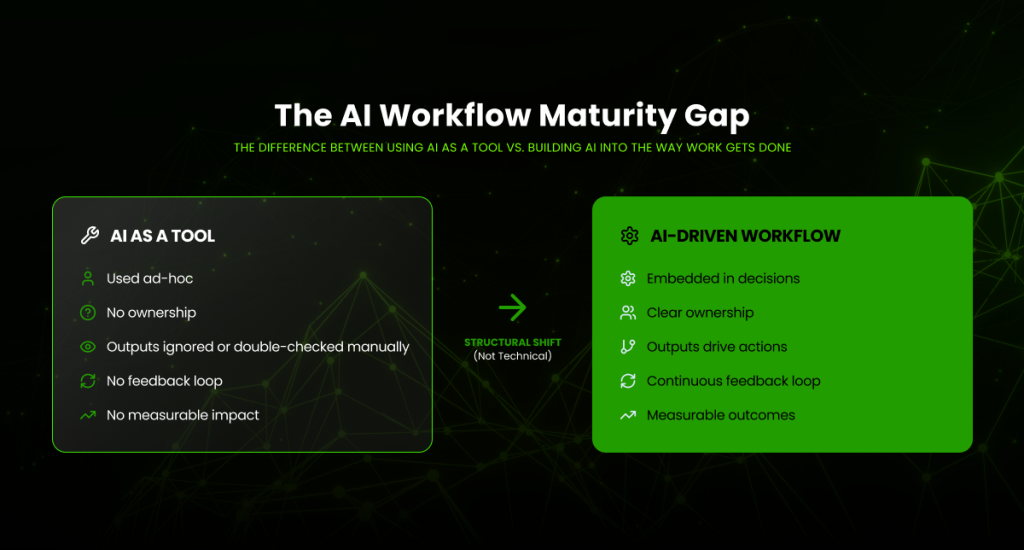
A workflow is AI-driven when the model is a participant, not a resource. It makes or informs decisions, routes tasks, generates outputs that trigger downstream actions. That’s different from a chatbot that drafts your emails or an API call inside a script. In a genuinely AI-driven workflow, the model shapes how work gets done at a system level, and that distinction changes what preparation actually requires.
Step 1: Map what you're already running
Before building anything new, figure out what you already have.
Most teams are surprised by how much AI they already have once they look. For every tool running a model under the hood, a code assistant, a support chatbot, an automated labeling system, a recommendation engine, ask four questions:
- Who owns it?
- What does it output?
- Who acts on those outputs?
- What happens when it’s wrong?
That last one is diagnostic. In most organizations the honest answer is: nothing structured. A bad result surfaces, a human catches it eventually, and there’s no mechanism for the system to improve. That’s not an AI-driven workflow. It’s an AI tool duct-taped to a manual process.
Step 2: Sort out your data before anything else
This is where most AI initiatives fall apart, and usually before anyone admits it publicly.
Data preparation accounts for 60-80% of the effort in successful AI implementations, which means most of the real work happens before the model is even involved.
AI-ready data means:
- Structured for the specific task the model will perform
- Actively governed
- Flowing through automated pipelines
- Continuously monitored
That last point is where most teams fall short. Traditional data management runs on reporting cycles. AI systems in production need data quality signals in hours. When you’re used to monthly audits, that’s a real shift.
Before redesigning any workflow around a model, ask whether the data feeding it is consistent, documented, and continuously validated. If the answer is “probably” or “I think so,” that uncertainty will find you in production, usually at the worst possible moment.
Step 3: Designing workflows around AI
The pattern repeats constantly: a team adds an AI tool to an existing process. The process stays unchanged. People start quietly working around the tool, double-checking outputs, ignoring recommendations, reverting to manual steps that feel more reliable. More friction, not less. Real AI-driven workflows are designed with AI as a participant from the start. Before launch, you need clear answers to:
- Where can the model make or recommend a decision with high confidence?
- What happens when confidence is low?
- Who reviews edge cases, and under what conditions?
- How are those rules enforced inside the system, not just agreed in a doc?
The workflows that actually scale treat uncertainty as a design input.
Step 4: Build the feedback loop before you launch
AI systems in production degrade gradually and quietly, as real-world data drifts from training data and edge cases accumulate. Teams that catch this early build feedback mechanisms from day one.
A feedback loop doesn’t need to be sophisticated. At minimum it needs to:
- Define what good output looks like before deployment
- Capture human corrections when they happen
- Route that signal back into the system
- Set clear thresholds for when retraining or recalibration is needed
Without this, you’re running a system with no way of knowing when it’s getting worse. And by the time the degradation is obvious to users, it’s usually been building for a while.
Step 5: Don't confuse pilot conditions with production reality
Pilots are built to succeed. Small team, clean data, narrow scope, a motivated person manually managing every edge case. Production is the opposite of all that.
46% of AI pilots are scrapped between proof of concept and broad adoption. The most common reason it’s that the pilot worked under conditions that don’t exist at scale. When teams tried to expand, they discovered the workflow needed 15 manual steps across four different tools. It ended up slower than the process it was supposed to replace.
Design pilots like small versions of the real thing, not experiments with special rules. That means:
- Using realistic data
- Involving the people who will actually run the workflow day-to-day
- Including the edge cases
- Measuring against outcomes
A technically impressive model that nobody trusts or uses isn’t a success.
Step 6: Set up governance before you need it
Most organizations think about AI governance after something goes wrong. Governance doesn’t need to be bureaucratic, but it does need to answer a few things clearly:
- Who owns the output of a model-driven decision?
- What does the audit trail look like?
- How is sensitive data handled inside the pipeline?
- What’s the rollback process when a model behaves unexpectedly?
- Which decisions can AI make on its own, and which always need a human in the loop?
These questions feel hypothetical until they’re urgent, which tends to happen at the worst possible moment. The organizations that scale AI without major incidents treated governance as a design requirement from the start.
Step 7: Preparing your team
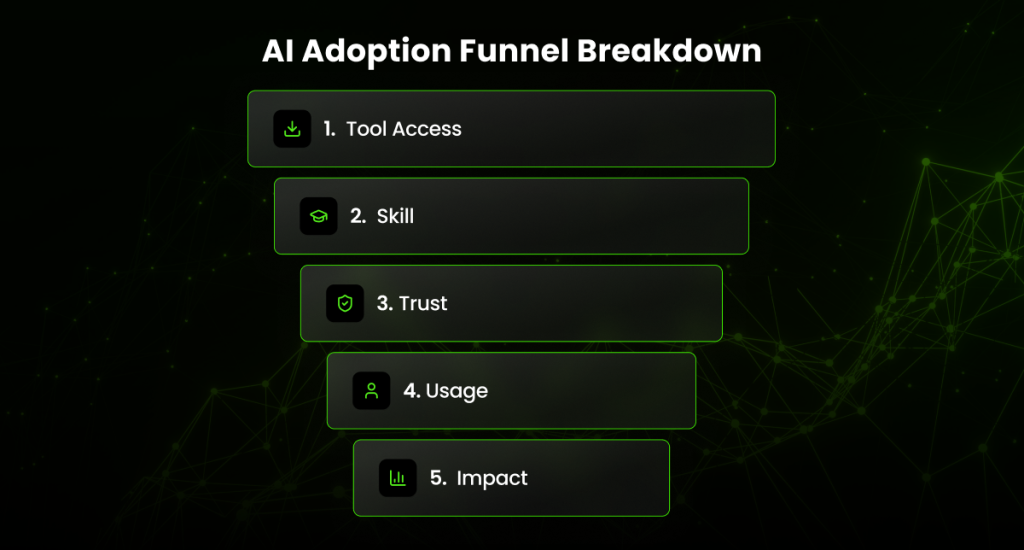
The tools are rarely the problem. Most AI implementation failures trace back to people and process: cultural resistance, unclear ownership, teams handed a tool without understanding how it fits their actual work.
Team readiness has two components that often get conflated:
- Skill: whether people know how to use the tools effectively
- Trust: whether people believe the tools produce outputs worth acting on
Training handles the first. Trust is harder. It gets built through visible wins, transparent systems, and giving people enough context to understand why a model produced a given output. Start with lower-stakes decisions where the cost of being wrong is small, let people see the system work, and expand from there.
The window for easy wins is closing
The workflow automation market is projected to reach $40.77 billion by 2031. The investment is real and accelerating. But the teams pulling ahead aren’t the ones with the biggest budgets or the most sophisticated models. They’re the ones that did the unglamorous work first: data infrastructure, governance, workflow redesign, team trust.
Get the foundations right and AI-driven workflows become a genuine advantage. Skip them and you end up with a great-looking pilot and a rollout that quietly stalls.