

Who decides what counts as a strength in the workplace?
For decades, many professional environments, especially in tech, have defined leadership through a narrow lens: decisiveness, authority, and visible confidence. But the modern workplace is evolving. Research increasingly shows that qualities once labeled as “soft skills” are actually critical drivers of team performance, innovation, and long-term success.
Yet many of these strengths are still misunderstood, particularly when they are expressed by women in leadership. Empathy can be mistaken for indecisiveness. Confidence can be perceived as arrogance. Direct communication may be labeled as “difficult”.
In celebration of International Women’s Day, we wanted to highlight strengths that are too often mislabeled as weaknesses, by sharing the perspectives of five incredible women in our company.
Because strength at work doesn’t always look the way we expect.
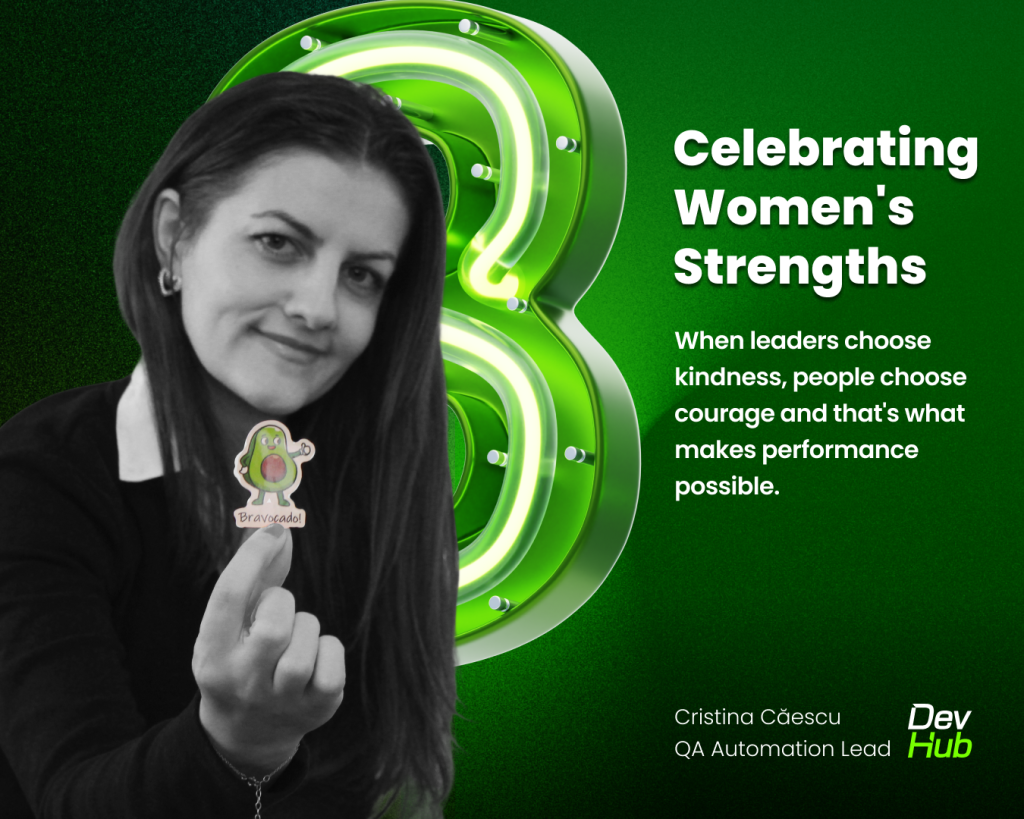
Empathy in Leadership: The Power of Being “People-Oriented”
Cristina Căescu, QA Automation Lead
“One trait often labeled as a weakness in women is being “too people-oriented.” In many professional environments, especially in tech, empathy can be misunderstood as softness, lack of authority, or hesitation to make difficult decisions. But in my experience, empathy is not the opposite of strong leadership, it is what makes strong leadership sustainable.
Throughout my career, from mentoring and people management to my current role as a QA Automation Lead, I’ve learned that real influence doesn’t come from hierarchy alone. It comes from trust. When people feel genuinely seen, heard, and valued, something shifts. They show up with more ownership, creativity, and courage. Empathy creates psychological safety, and psychological safety is what allows people to perform at their best.
Earlier in my journey, being approachable or collaborative sometimes led others to underestimate my leadership potential. But over time, the impact became clear. Teams formed naturally, motivation increased, and people grew, not because they were controlled, but because they were supported. What is often called a “soft skill” is actually a strategic leadership capability: understanding human dynamics, sensing what people need to succeed, and creating environments where people feel confident enough to stretch beyond their limits.
Leadership isn’t only about delivering outcomes. It’s about building people who can deliver them again and again. For me, kindness in leadership means choosing to see potential, building trust, and making courage possible in others. And when people feel safe enough to be courageous, performance naturally follows.”
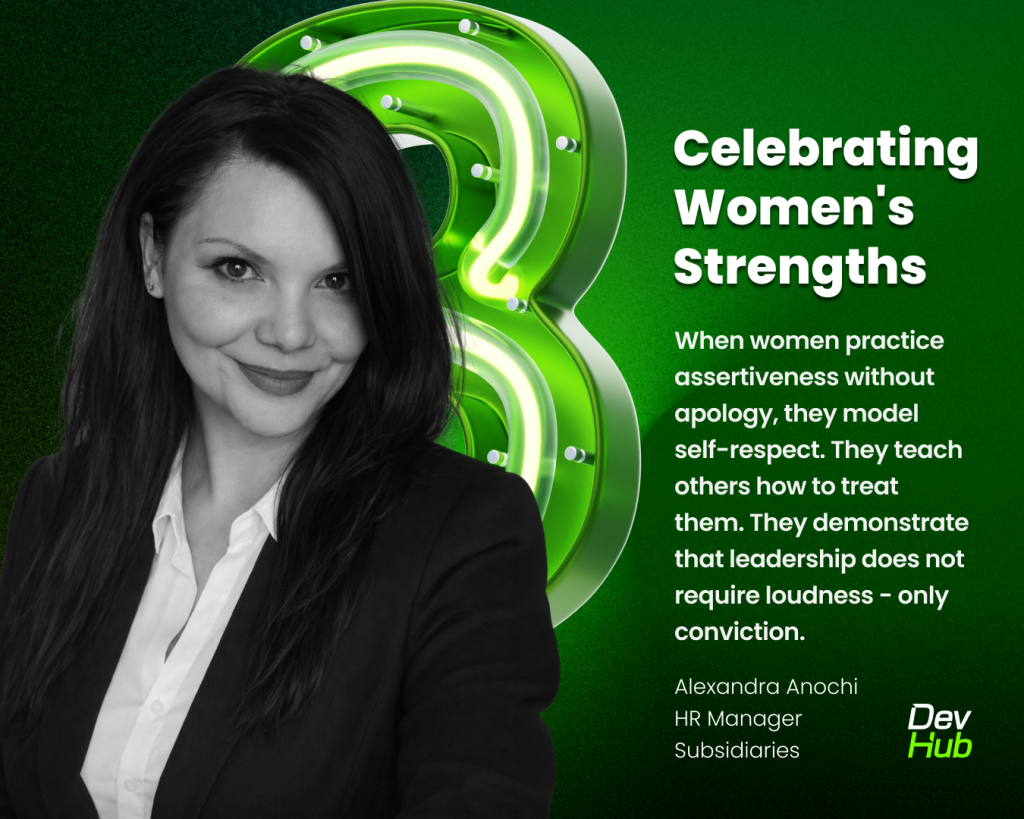
Assertiveness at Work: Why Clear Communication Is a Leadership Skill
Alexandra Anochi, HR Manager
“When a woman speaks directly, sets boundaries, or advocates for herself, she may be labeled bossy, difficult, abrasive, or cold. Yet the same behaviors in men are frequently described as confident, decisive, or strong leadership.
The difference isn’t the behavior. It’s the expectation. At its core, assertiveness is simple: the ability to express thoughts, needs, and boundaries clearly and respectfully. It is not aggression. It doesn’t require hostility. And it does not diminish others. Assertiveness simply says: “This is where I stand.”
When reframed as a strength, assertiveness becomes:
- Clarity – Direct communication reduces confusion and prevents resentment.
- Boundary protection – Saying no protects time, energy, and mental health.
- Professional leverage – Assertiveness improves negotiation outcomes, compensation, and career advancement.
- Emotional maturity – It replaces passive frustration or explosive reactions with calm, direct expression.
Many women are taught to prioritize harmony over self-advocacy. But suppressed needs don’t disappear, they surface as burnout, frustration, or disengagement. Assertiveness prevents that cycle. It creates honest dynamics where expectations are explicit rather than implied. Assertiveness and warmth are not opposites. A person can be kind and clear. Compassionate and firm. Collaborative and decisive. When women practice assertiveness without apology, they model self-respect and demonstrate that leadership does not require loudness, only conviction.”
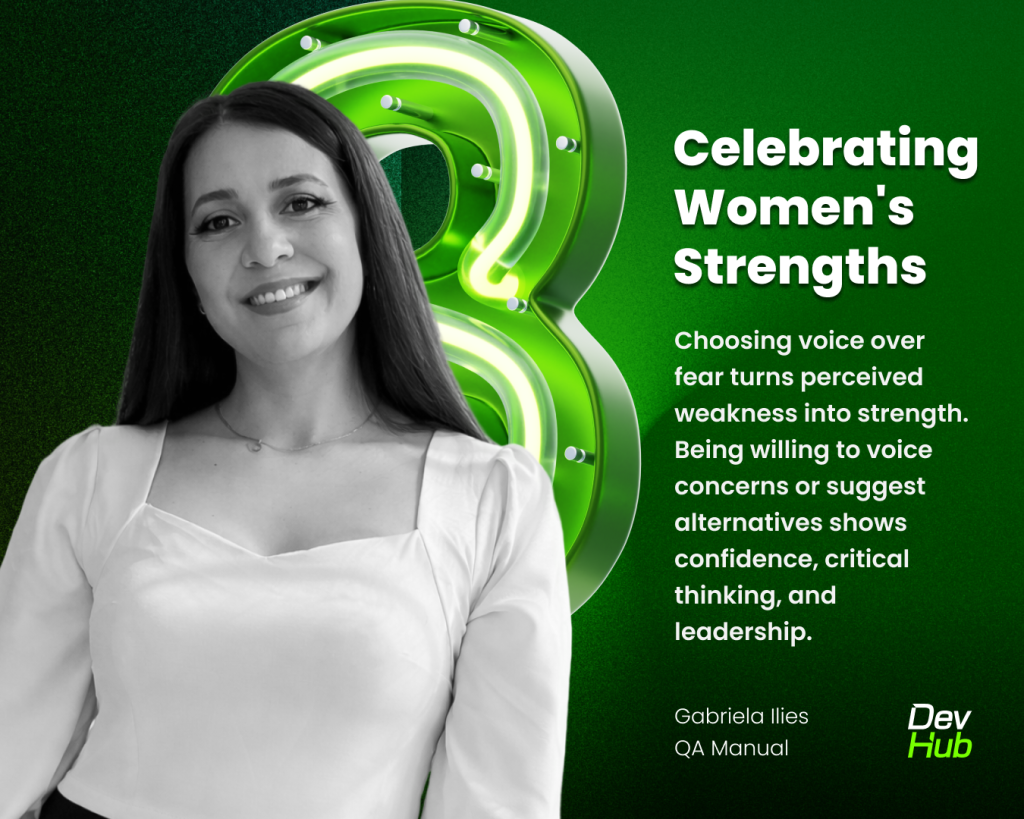
Speaking Up at Work: Turning Courage Into Leadership
Gabriela Ilieș, QA Manual Tester
“In some environments, questioning ideas or proposing alternatives may be perceived as being difficult or confrontational. But in reality, this behavior reflects confidence, critical thinking, and accountability, qualities that strengthen teams and organizations.
Progress rarely comes from silent agreement. It comes from people who are willing to examine assumptions, raise concerns, and explore better solutions. Choosing voice over silence helps teams avoid mistakes, uncover blind spots, and refine processes.
Speaking up is not about opposing others, it’s about contributing to better outcomes. Voicing concerns or suggesting alternatives demonstrates ownership. It shows that someone cares deeply about the quality of the work and the success of the team. When courage replaces hesitation, a perceived weakness becomes a powerful leadership strength.”
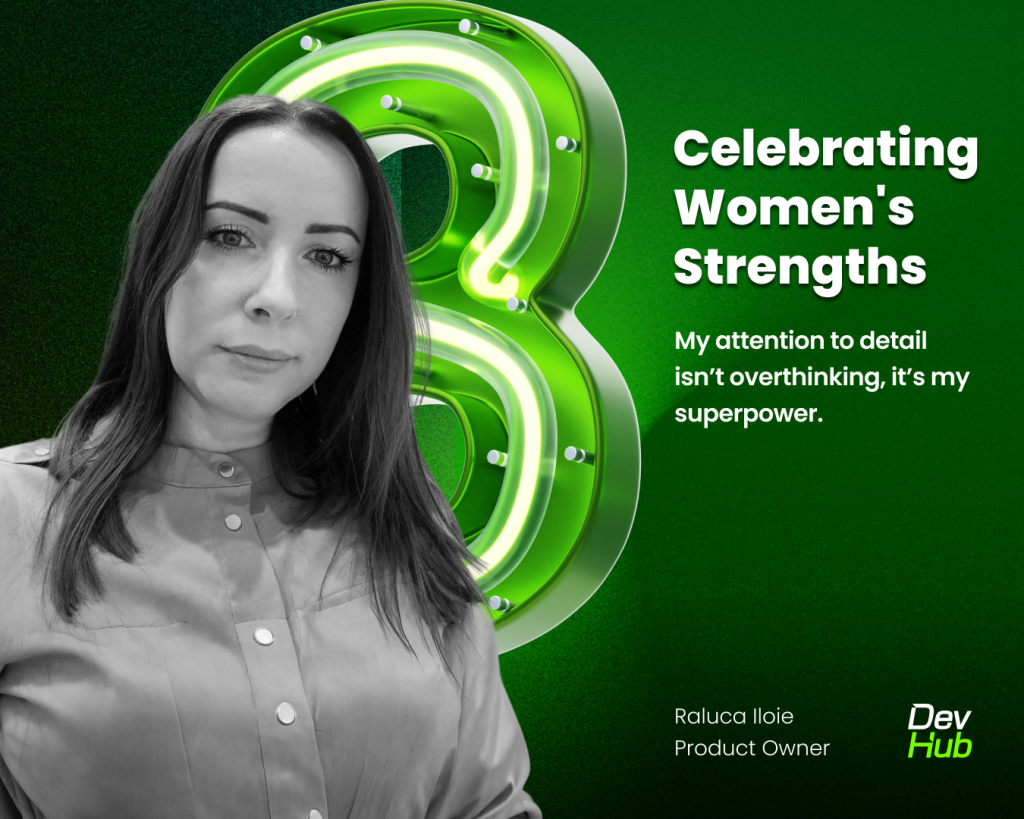
Attention to Detail: The Hidden Advantage in Product Leadership
Raluca Iloie, Product Owner
“As a Product Owner, one of my biggest strengths is also one most often mislabeled in women: attention to detail paired with active memory. I notice things. I retain things.
That requirement we discovered two months ago? I remember why we discovered it and when the context shifts and it suddenly matters again, that memory is what saves us from going in circles. That nuance a stakeholder mentioned almost in passing?
It becomes the thing that keeps a UX decision coherent three sprints later.
Where others zoom out to stay objective and scope-focused (also a valid and necessary skill), I zoom in. And that complementary perspective is what brings clarity to the table. No noise. Clarity. Attention to detail isn’t overthinking. It’s pattern recognition with a long memory. And in product development, that’s gold.”
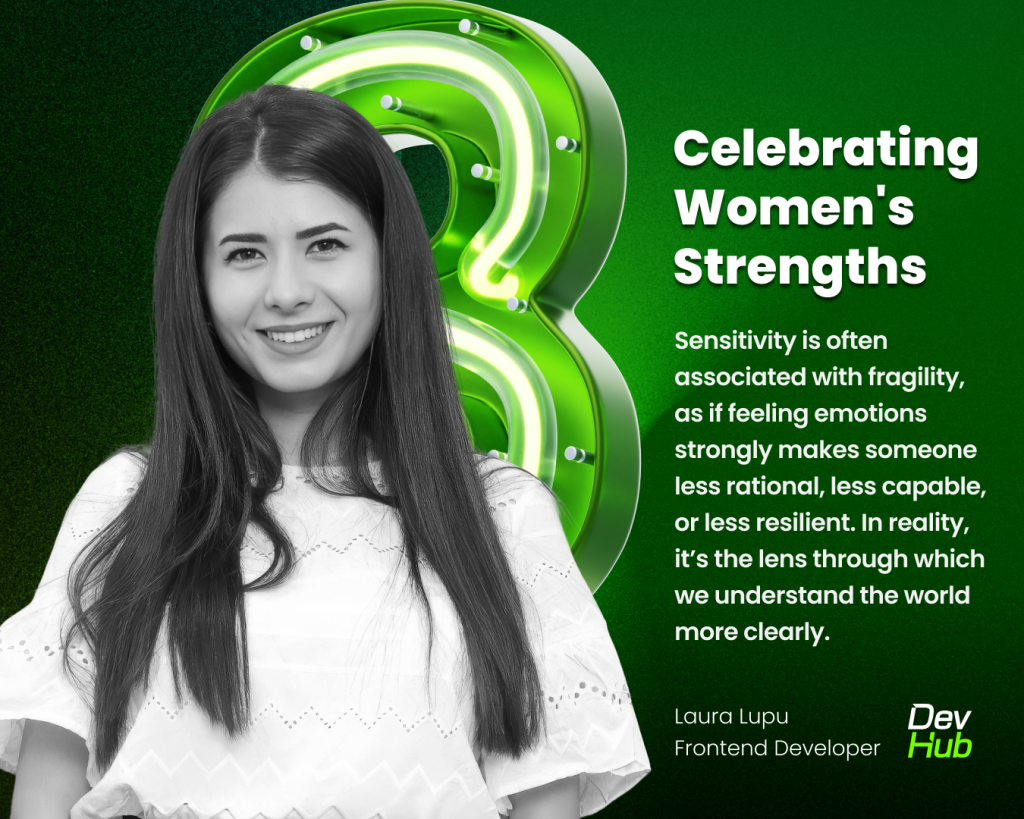
Emotional Sensitivity: The Strength Behind Empathy and Creativity
Laura Lupu, Frontend Developer
“A trait often labeled as a weakness in women, but that I believe should be recognized as a strength is emotional sensitivity.For a long time, sensitivity has been misunderstood. It is often associated with fragility, as if feeling emotions strongly makes someone less rational, less capable, or less resilient.
Women in particular are often told they are “too sensitive” or encouraged to hide that side of themselves to be taken seriously. But emotional sensitivity is not a limitation, it is a form of awareness. People who are sensitive tend to notice things others might ignore: subtle changes in tone, the emotions behind someone’s words, or the atmosphere in a room. This ability creates stronger empathy and understanding. It allows someone to connect with others more genuinely and to respond with compassion rather than indifference.
Sensitivity can also be a source of strength when facing challenges. Feeling deeply does not mean someone is unable to handle difficulty. In many cases, it means they process experiences more thoughtfully and grow from them in meaningful ways. Being in touch with emotions can help a person better understand themselves, their values, and the people around them.
In addition, sensitivity often plays an important role in creativity and communication. Many people who are emotionally perceptive are also able to express ideas, stories, and emotions in ways that resonate with others. This capacity to reflect on feelings and human experiences can lead to deeper insight and stronger relationships. For these reasons, I think sensitivity should not be dismissed as a weakness. Instead, it should be recognized as a different kind of strength, one that is quieter but just as powerful.
Being sensitive means having the courage to remain open, empathetic, and aware in a world that sometimes encourages people to become detached. And in my opinion, that ability to feel deeply and still remain strong is something worth valuing, not hiding.”
Final Thoughts: Redefining Strength in the Modern Workplace
The workplace is evolving, and so is our understanding of leadership. Empathy, assertiveness, attention to detail, emotional awareness, and the courage to speak up are essential skills Many of the traits historically labeled as “soft” are actually the foundations of strong teams and resilient organizations.
Our colleagues remind us that leadership comes in many forms and that strength is often quieter, more human, and more powerful than traditional stereotypes suggest.
The future of work will belong to organizations that recognize and value these strengths.When people feel safe to lead authentically, everyone performs better.