
The Part of Design No One Talks About
For a long time, design was not only about ideas. A large part of it lived in repetition. Resizing assets for different formats, cleaning up backgrounds, rebuilding the same visual in multiple versions, adapting layouts again and again once a campaign started moving. None of that was the part people usually associate with design, yet it shaped how the work felt every day.
What made it frustrating was not just the time it took. It was the fact that production sat right in the middle of the creative process. The more time went into execution, the less space remained for judgment, exploration, and actual creative direction. On busy campaign weeks, especially, the important questions got pushed to the margins. Not what looks best. Not what communicates most clearly. Just what can be finished in time.
That is the part AI changed first. Not the big idea, not the final layer of craft, but the invisible production weight that used to eat through the work before the real thinking had a chance to happen.
The Real Shift Is Not Speed
Most conversations about AI in design focus on speed, and yes, speed matters. Tasks that used to take hours can now take minutes. Variations can be generated quickly, assets can be adapted across formats, rough visual directions can be tested without rebuilding everything manually from scratch. But the more important shift is not speeding alone. It is where attention goes once speed is no longer the main bottleneck.
In my own workflow, the role of execution has become smaller, while the role of judgment has become much bigger. I spend less time producing the work and more time evaluating it. Comparing options. Stress-testing directions. Deciding what is actually worth refining and what only looks interesting at first glance. The work has become less about pushing pixels for the sake of output and more about making better choices earlier.
That changes the nature of design work more than any time-saving feature does. AI does not remove the need for design thinking. It makes weak thinking more visible, faster.
From Making Assets to Making Decisions
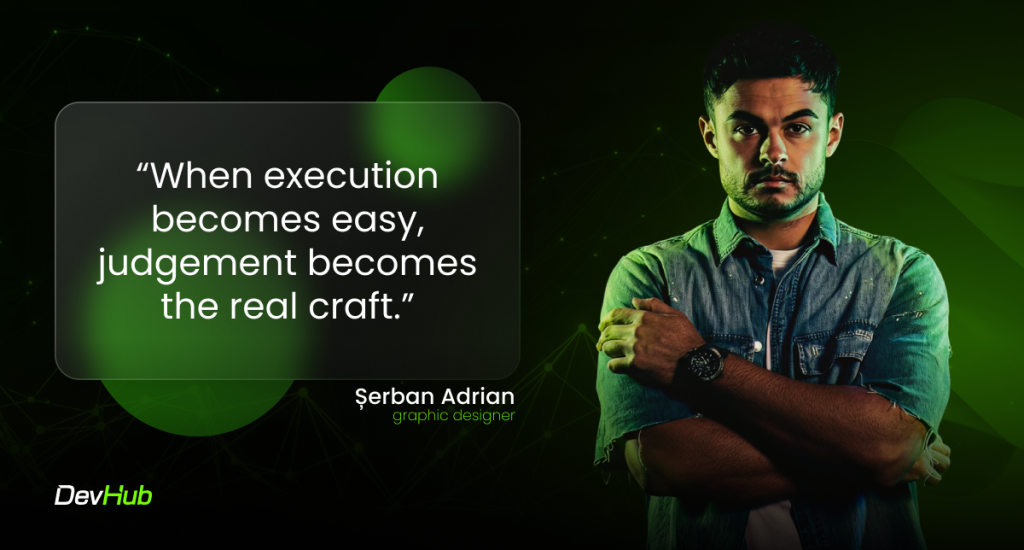
This is where I think the role of the designer is changing in a more meaningful way. When production becomes easier, design is no longer defined by how quickly you can execute. It is defined more clearly by how well you can decide.
That sounds subtle, but in practice it is a major shift. A designer now has access to more options, more quickly, and that means the real skill is not generating more. It is knowing what deserves to move forward. Which direction has clarity, not just novelty. Which variation actually supports the message instead of just looking polished. Which visual idea feels intentional rather than machine assisted. In other words, AI changes the threshold of the work. Execution is becoming cheaper. Discernment becomes more valuable.
That also means design teams need to be careful about what they reward. If speed becomes the only benchmark, the output may grow while the thinking gets thinner. More options do not automatically mean better work. In some cases, they simply create more noise to sort through.
Experimentation Has Become Easier, but Also More Demanding
One of the biggest benefits of AI is how much friction it removes from experimentation. Trying different directions used to require a meaningful investment of time, so naturally, some ideas never got tested. Now it is much easier to explore multiple approaches early, compare them side by side, and develop a stronger sense of what works before committing too soon.
That has made the design process feel more flexible and more open. I can move across several directions at once, test rough ideas earlier, and treat exploration as part of the workflow rather than a luxury that only happens when there is extra time.
But there is another side to that. When experimentation becomes cheap, curation becomes harder. The challenge is no longer generating possibilities. It is avoiding shallow abundance. AI can produce many directions very quickly, but quantity can create the illusion of depth. A wider range of options is only useful if someone is able to recognize which ones have substance and which ones are just variations without insight.
That is why I still see AI as a strong starting layer, not a replacement for refinement. It is useful for opening the field, but the quality of the final outcome still depends on judgment, editing, and craft.
The Blank Canvas Is Not Really Blank Anymore
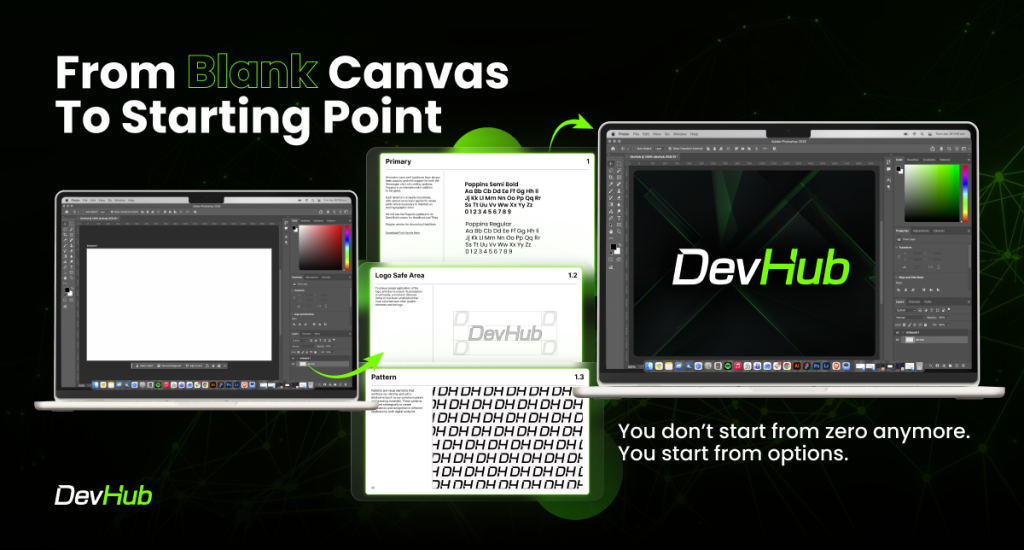
Another clear shift is how projects begin. I do not always start from zero anymore. Sometimes I start with a generated base, a rough structure, a visual prompt, or an early composition that gives me something to react to. That changes the emotional weight of the blank canvas. Starting becomes easier because the first step is no longer pure creation. It is response, selection, and shaping.
That can be incredibly useful in early-stage concepting, especially when speed matters or when a project needs several possible directions before the strongest one becomes obvious. It allows momentum to build faster.
At the same time, starting from generated material also requires discipline. It is easy to inherit visual logic that was never consciously chosen. It is easy to accept a decent first output instead of pushing toward something sharper. That is why traditional tools and manual refinement still matter so much. Figma, Photoshop, and the rest of the design stack remain essential because the final layer of quality still comes from deliberate decisions, not automatic ones.
AI can accelerate the start. It cannot replace the eye.
What Teams Still Get Wrong About AI in Design
The most reductive way to look at AI in design is to treat it as a productivity shortcut. That view is too narrow. Yes, it reduces repetitive work. Yes, it accelerates iteration. But its bigger effect is that it reshapes where design value comes from.
The designer becomes less of a production engine and more of a filter, editor, and decision-maker. The work shifts from manual repetition toward direction-setting. From making every version by hand toward knowing which version deserves to exist in the first place.
That is why I do not think the conversation should be framed as a human versus tool. The more useful question is what kind of designer this workflow favors. In my view, it favors designers who can think clearly, critique well, and maintain standards when the volume of possible output increases. It rewards judgment more than effort alone.
And that may be the most important change of all. AI does not diminish the role of the designer. It exposes what the role actually was underneath the production load the whole time.
Final Thoughts
AI has absolutely changed the way I work. It has made repetitive tasks faster, made experimentation more accessible, and made early-stage exploration much less rigid. But the real value is not that everything moves faster. It is that the work now leaves more room for the part that matters most.
Not just execution, but evaluation. Not just output, but intent. Not just making more, but recognizing what is worth making.
That is the shift I keep noticing in practice. As production gets easier, judgment becomes the real craft.